
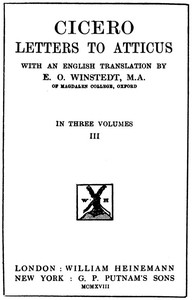
Cicero: Letters to Atticus, Vol. 3 of 3 by Marcus Tullius Cicero
Forget dry historical accounts. This book is a real-time diary of a political nightmare. Volume 3 drops us right into the heart of Rome's civil war. Julius Caesar has defied the Senate and marched on Rome. The old political system is shattered. We follow Cicero, now in his late 50s, as he is torn between his loyalty to the Republic's ideals and the brutal reality of Caesar's power. The 'plot' is history itself unfolding: Caesar's victory, his dictatorship, and finally, his murder by a group of senators.
The Story
Cicero isn't fighting on the front lines. He's struggling with a more personal battle: what to do. Should he join Pompey's forces? Should he try to negotiate? Should he just keep his head down? The letters show him agonizing over every decision. After Caesar wins, Cicero is pardoned but pushed to the sidelines. We see his bitter retirement, his focus on writing philosophy, and his quiet despair. Then, the conspiracy forms. Cicero wasn't one of the assassins, but he approved of the act. The final section of the letters captures the wild, brief hope after Caesar's death, followed swiftly by confusion and dread as Mark Antony takes center stage and the hoped-for renewal of the Republic fails to materialize.
Why You Should Read It
This is where Cicero becomes profoundly human. We see the gap between his public speeches and his private fears. He complains about money, worries about his son's education, and gets genuinely scared for his life. His intelligence is obvious, but so are his miscalculations and vanity. Reading these letters, you don't just learn about history; you feel its weight and its terrifying uncertainty. You understand that the people who lived through it had no idea how it would end. Cicero's hope after Caesar's death is almost painful to read, because we know the civil wars are about to start all over again.
Final Verdict
This isn't an easy beach read, but it's an incredibly rewarding one. It's perfect for anyone who loves political drama, biographies, or stories about smart people in impossible situations. You don't need to be a classics scholar; you just need an interest in human nature under pressure. If you've ever wondered what politicians really think when the cameras are off, this is the original, uncensored version. It's a masterclass in how ideals crash against the hard rocks of power, written by a man who was both a brilliant observer and, ultimately, a victim of the times he documented.
This is a copyright-free edition. You can copy, modify, and distribute it freely.
James Lee
2 years agoFrom a researcher's perspective, the practical checklists included are a great touch for real-world use. This adds significant depth to my understanding of the field.
Ashley Thomas
3 months agoA brilliant read that I finished in one sitting.
Richard Martinez
1 year agoI started reading this with a critical mind, the critical analysis of current industry standards is very timely. I'll be recommending this to my students and colleagues alike.
Liam Brown
2 months agoThis book was worth my time since the flow of the text seems very fluid. A valuable addition to my collection.
Sarah Gonzalez
7 months agoAfter a thorough walkthrough of the table of contents, the practical checklists included are a great touch for real-world use. This exceeded my expectations in almost every way.