
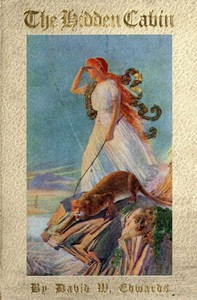
The Hidden Cabin: a pathetic story in condensed form by David W. Edwards
I picked up David W. Edwards's 'The Hidden Cabin' expecting a quick historical curiosity. What I got was a surprisingly powerful snapshot of loneliness that has stuck with me for days. Published in 1849, it's less a novel and more a carefully composed moment, stretched out just enough to let its sadness sink in.
The Story
The plot is beautifully simple. A traveler, lost in a dense forest, stumbles upon a small, crumbling cabin completely swallowed by nature. Forcing his way inside, he finds it not abandoned in haste, but preserved in a kind of eerie stillness. He finds a chair by a cold hearth, a few worn books, simple tools, and signs of a solitary, self-sufficient life. There are no journals spelling out a tragic past, no obvious clues. Just the quiet evidence of a person who lived and died there, utterly removed from the world. The story is in the traveler's realization as he pieces together this life from its remnants, feeling the profound isolation of the place seep into his own bones.
Why You Should Read It
This book's power is in its restraint. Edwards doesn't tell us a melodrama; he shows us the aftermath of a quiet life and lets us feel the gap where the person used to be. It makes you wonder about that person's dreams, their regrets, and the peace they might have found—or failed to find—in their solitude. The 'pathetic' in the subtitle isn't about pity, but about pathos, a genuine evocation of emotion. In our loud, connected world, this story about total disconnect hits differently. It's a meditation on what we leave behind, not in grand monuments, but in the wear on a floorboard or the placement of a cup.
Final Verdict
This isn't for someone looking for a plot-driven adventure. It's for the reader who enjoys atmospheric, reflective fiction and doesn't mind a story that leans into melancholy. It's perfect for a thoughtful afternoon, maybe with a cup of tea, when you're in the mood to be quietly moved. Fans of authors like Marilynne Robinson or Kazuo Ishiguro, who find deep meaning in quiet moments, will appreciate its spirit, even though it's from a completely different century. Think of it as a haunting, beautifully composed photograph from the past—a single frame that implies a whole life.
This is a copyright-free edition. Distribute this work to help spread literacy.
Andrew Sanchez
6 months agoTo be perfectly clear, the plot twists are genuinely surprising. Exceeded all my expectations.
Daniel Davis
1 year agoA bit long but worth it.
Donald Ramirez
1 year agoUsed this for my thesis, incredibly useful.
Joseph Brown
6 months agoFinally a version with clear text and no errors.







Jennifer Williams
1 year agoMy professor recommended this, and I see why.