About 136 minutes
August First — Context and Discussion
Classic Romance
31,160 recorded words. 14 minutes difference from this book's estimate.
View Gutenberg source #18529
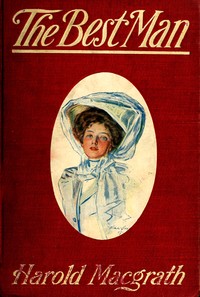
The source record for The Best Man — Story, Setting & Ideas measures this digital text at 34,278 words, 2 hr 30 min estimated reading time, and 4 detected text sections.
The text analysis averages about 12.7 words per sentence, while the detected sections provide another way to judge how the source is divided.
Project Gutenberg metadata also associates the work with “United States -- Social life and customs -- Fiction,” connecting these edition facts with the source record’s subject description.
Explore this collection
These alternatives are selected using recorded categories and estimated reading time.
About 136 minutes
Classic Romance
31,160 recorded words. 14 minutes difference from this book's estimate.
View Gutenberg source #18529About 134 minutes
Classic Romance
30,818 recorded words. 16 minutes difference from this book's estimate.
View Gutenberg source #10608About 127 minutes
Classic Romance
29,136 recorded words. 23 minutes difference from this book's estimate.
View Gutenberg source #64128Search stored excerpts and compare books → Choose by your preferences →
Choices use stored catalog measurements. Estimates vary with reading speed. A shared category is a catalog label, not a claim that two books have the same argument or literary quality.
Search reads excerpt text stored with this catalog and links to its associated Gutenberg record. The connection is stored in the site database; this tool does not recheck that every excerpt is word-for-word identical to that external record. Excerpt search does not cover every chapter and does not verify historical publication dates.
Catalog snapshot checked: 2026-09-26. Coverage: 89 public books, 89 available source excerpts.
Calculated from edition completeness, EPUB availability, text structure and catalogue metadata. Not a user rating.
Total of 100 points, scaled to a 2.5-5.0 range. Editions with an empty description or a missing EPUB file are not scored.
Public-domain source text
The source text is kept in the dedicated reader, separate from this catalogue record and its commentary.
Harold MacGrath's The Best Man opens with Carrington balancing a folded document on his palm, a gesture that immediately establishes the story's central tension between written obligations and emotional impulses. The narrative voice shifts between interior monologue and crisp dialogue, often punctuated by sensory details—the drone of a typewriter, the smell of summer flowers, the sight of ships on the river. These atmospheric touches ground the moral dilemmas in a tangible world. The collection includes three additional stories: 'Two Candidates,' 'The Advent of Mr. 'Shifty' Sullivan,' and 'The Girl and the Poet,' each exploring variations on love, ambition, and the compromises demanded by society.
The title story repeatedly returns to documents as physical markers of choice. Carrington's folded paper, described as a 'monument to one man's greed,' becomes a symbol of the power to expose or conceal. Later, Newcomb produces a portrait from among old papers, shifting the weight from legal evidence to personal memory. MacGrath uses these objects to externalize internal conflicts: the document is balanced, the portrait is studied. The act of holding, folding, or putting away these items mirrors the characters' hesitation and resolve. In 'Two Candidates,' the political machinery hinges on lists and appointments, while 'The Advent of Mr. 'Shifty' Sullivan' likely involves written agreements or records. This recurring motif ties the stories together, suggesting that love and duty are often negotiated through tangible tokens of commitment or betrayal.
MacGrath's settings shift between office interiors and urban vistas, using the city to reflect the characters' ethical landscapes. Carrington sees 'the smoking, ragged sky-line' and 'the shifting, glittering river' from his window—a view that suggests both opportunity and instability. Newcomb, alone in his office at night, studies the darkness outside, his dreams of reform clashing with the ward's political realities. The city is never neutral; it breathes summer scents or looms as a backdrop for ambition. In 'The Advent of Mr. 'Shifty' Sullivan,' the title itself hints at urban trickery, while 'The Girl and the Poet' may contrast city and pastoral ideals. These environments are not mere decoration but active forces that shape the characters' choices, reinforcing the theme that personal integrity is tested in public spaces.
Dialogue in these stories often takes the form of argument or persuasion, with characters trying to sway one another toward or away from ethical action. In the title story, Carrington's internal debate is externalized through imagined voices: 'So many voices spoke that he seemed to hear none distinctly.' Later, McDermott advises Newcomb to use the document as leverage, calling it 'the only way out.' Newcomb rejects this as blackmail, asserting his 'sense of right.' These exchanges are crisp and pointed, revealing character through moral stance rather than lengthy exposition. The stories rarely feature extended monologue; instead, they rely on back-and-forth that mimics the push-and-pull of conscience. Even the love interest is introduced through Newcomb's silent study of her portrait, a one-sided conversation with memory.
Romantic love in MacGrath's stories is often described in terms of light and navigation. Newcomb's love for the woman in the portrait is 'the serene light, the steady burning light, that guides the ships at sea.' This metaphor contrasts with the flickering, uncertain light of political maneuvering. Love provides constancy in a world of shifting alliances and moral gray areas. Yet the stories do not present love as a simple solution; it is another battlefield where duty and desire collide. Carrington worries that exposing the document will destroy his own happiness and hers. Newcomb acknowledges that his friend Dick also loves the same woman, setting up a rivalry that tests friendship. MacGrath treats love as a force that demands sacrifice and clarity, not merely a reward for virtue.
Readers approaching The Best Man will find a collection that rewards attention to small details—the weight of a document, the angle of a portrait, the view from a window. MacGrath builds his moral dramas from these concrete elements, allowing the reader to observe characters as they weigh choices. The four stories share a concern with integrity under pressure, but each offers a distinct situation and resolution. For those interested in early twentieth-century American romance and political fiction, this volume provides a compact, varied sample of MacGrath's craft.
There’s something about MacGrath’s men, caught between what they want and what they owe, that lingers long after the page turns. I found myself thinking of that same quiet ache while rereading The Tracer of Lost Persons — how a search for someone else often turns into a search for oneself. The Tracer of Lost Persons — Inside the Classic felt like an old friend’s familiar handwriting, unhurried and true.
Capture what you thought, learned, and would like to remember.