About 369 minutes
The Younger Sister: A Novel, Vol. III. — Background and Themes
Classic Romance
84,778 recorded words. 2 minutes difference from this book's estimate.
View Gutenberg source #54012
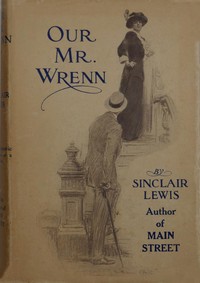
The source record for Our Mr. Wrenn: The Romantic Adventures of a Gentle Man — Story, Setting & Ideas measures this digital text at 84,247 words, 6 hr 7 min estimated reading time, and 21 detected text sections.
The text analysis averages about 14.2 words per sentence, while the detected sections provide another way to judge how the source is divided.
Project Gutenberg metadata also associates the work with “Love stories,” connecting these edition facts with the source record’s subject description.
Explore this collection
These alternatives are selected using recorded categories and estimated reading time.
About 369 minutes
Classic Romance
84,778 recorded words. 2 minutes difference from this book's estimate.
View Gutenberg source #54012About 328 minutes
Classic Romance
75,412 recorded words. 39 minutes difference from this book's estimate.
View Gutenberg source #13396About 326 minutes
Classic Romance
74,859 recorded words. 41 minutes difference from this book's estimate.
View Gutenberg source #67979Search stored excerpts and compare books → Choose by your preferences →
Choices use stored catalog measurements. Estimates vary with reading speed. A shared category is a catalog label, not a claim that two books have the same argument or literary quality.
Search reads excerpt text stored with this catalog and links to its associated Gutenberg record. The connection is stored in the site database; this tool does not recheck that every excerpt is word-for-word identical to that external record. Excerpt search does not cover every chapter and does not verify historical publication dates.
Catalog snapshot checked: 2026-09-26. Coverage: 89 public books, 89 available source excerpts.
Calculated from edition completeness, EPUB availability, text structure and catalogue metadata. Not a user rating.
Total of 100 points, scaled to a 2.5-5.0 range. Editions with an empty description or a missing EPUB file are not scored.
Public-domain source text
The source text is kept in the dedicated reader, separate from this catalogue record and its commentary.
The novel opens not with grand declarations but with a brass-buttoned ticket-taker on Fourteenth Street. Mr. Wrenn, a meek bachelor in blue ready-made suits, seeks the man's cordial nod after a scolding from his office manager. This small ritual—a lonely man buying a moment of recognition—establishes the book's method: it builds character through modest, repeated gestures rather than dramatic incidents. The prose moves from the dusty wind of New York streets to the cramped desk where Wrenn bends over bills, then to the Nickelorion's flickering screen. Lewis anchors his story in physical details—the feel of a vest pocket for a nickel, the sight of Italian boys with violets under an elevated station—that give weight to Wrenn's inner life.
The book's twenty-one chapters trace a clear arc from confinement to release, but Lewis avoids a simple before-and-after structure. Early chapters alternate between Wrenn's office routine—where he is “Our Mr. Wrenn,” the reliable correspondence clerk—and his solitary evenings at moving-picture shows. The ticket-taker's nod becomes a recurring motif, a small kindness that Wrenn treasures because his furnished room offers none. When he finally sails for England, the narrative shifts to a different kind of confinement: the social awkwardness of a temperance inn, where he must navigate Istra's moods and his own uncertainty. Lewis structures the journey as a series of thresholds—the office door, the ship's gangway, the inn's entrance—each one a test of Wrenn's ability to step beyond his accustomed role.
Weather functions as more than atmosphere in these pages. The dusty wind that “whisked the skirts” of passersby on Fourteenth Street returns as a drenching rain on the English moor, soaking Wrenn and Istra as they tramp toward a ruined stable. Lewis describes the rain with physical precision: it comes “with a roar,” slapping faces and blinding eyes. The ruined stable—door off its hinges, thatch falling in—becomes a shelter that transforms Wrenn. For once, he stands “straight, the master,” ordering Istra onto the manger's edge. The rain that earlier seemed a punishment now provokes Istra's gleeful shout: “We're real vagabonds now!” Lewis uses weather to mark shifts in power and mood, turning discomfort into a kind of liberation.
Wrenn's speech reveals his character more sharply than any description. His characteristic exclamation is “Gee!”—uttered when he sees magazine covers or imagines foreign scenes. He thinks in tentative phrases: “Hope I see foreign stuff like that.” When he must assert himself, his commands come out as polite suggestions: “Come! We'll have something to eat here.” Istra's vocabulary is sharper, full of accusations (“You're hopeless”) and dramatic declarations (“Want to get away from myself”). The contrast between Wrenn's hesitant “I guess” and Istra's emphatic “I know what I'm talking about” drives their scenes together. Lewis never explains this difference; he lets the dialogue accumulate, each exchange adding another layer to Wrenn's gentle, uncertain voice.
The novel's geography is not merely backdrop but a structural device. New York appears as a series of confined spaces: the office behind the stock-room, the furnished room, the Nickelorion's booth. Even Fourteenth Street, with its elevated station and tramps, feels hemmed in by elevated tracks and dusty winds. England, by contrast, opens into desolate moorlands and ruined stables—spaces that are physically uncomfortable but psychologically freeing. The journey between these worlds is marked by transitional spaces: the ship, the train, the inn. Lewis pays close attention to how Wrenn moves through these thresholds, noting his prim steps, his fumbling for nickels, his awkwardness at ordering dinner. Each movement carries emotional weight, turning geography into a map of Wrenn's inner change.
Readers attentive to small details—the brass buttons on a ticket-taker's coat, the feel of a wet khaki sleeve, the sound of rain on thatch—will find Lewis's method rewarding. The novel does not announce its themes; it embeds them in the texture of everyday life. Pay particular attention to the moments when Wrenn acts without thinking, as when he drags Istra through the rain or commands her to eat. These are the cracks in his meekness, and they are easy to miss. The book rewards rereading for its quiet accumulation of such moments.
Your Mr. Wrenn with his blue suit and brass buttons—I knew that shrinking feeling, the way a familiar room can become a cage. It reminded me of being young and terrified, finding solace in The Blue Castle: a novel — Text and Context, where Valancy’s quiet rebellion felt like a shared secret. Both books whispered that change doesn’t need a loud voice.
Create a short personal record of your experience with this book.