
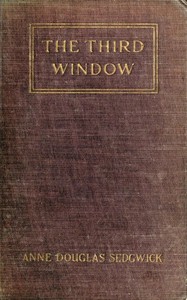
The Third Window by Anne Douglas Sedgwick
Published in 1920, The Third Window is a novel of quiet tension and emotional restraint. Anne Douglas Sedgwick, an American-born writer who spent much of her life in England, had a knack for exploring the inner lives of characters trapped by social conventions and personal history.
The Story
The story follows Christine, a young woman adrift after her mother's death. She finds a new home with her half-brother, Francis, a reserved and intellectual man twenty years her senior. He welcomes her into his beautiful but lonely country house, Bradmore. From the start, something feels off. Francis is kind but distant, wrapped in a sadness he won't explain. The heart of the mystery is a specific room in the house—the one with a distinctive third window. This room is always locked. Francis is visibly disturbed by it, yet he refuses to tell Christine why. The novel unfolds as Christine, with patience and care, tries to connect with her brother and understand the silent sorrow that walls him off from the world and locks away a part of his home.
Why You Should Read It
Don't come to this book for wild plot twists. Come for the atmosphere and the ache of human connection missed. Sedgwick builds a palpable sense of place; you can feel the quiet of the English countryside and the weight of the unspoken in those spacious rooms. The power is in the subtlety. Christine's struggle isn't against a villain, but against the polite, stifling norms of her time that treat deep grief as a private, almost shameful thing. Her brother isn't cruel—he's wounded and doesn't know how to ask for help. Their relationship, slowly thawing over shared walks and tentative conversations, is genuinely tender. It’s a masterclass in showing how love often works through small, patient gestures rather than grand declarations.
Final Verdict
This is a perfect read for a reflective afternoon. It will especially appeal to fans of character-driven historical fiction, like the works of Edith Wharton or Henry James (but a bit more accessible!). If you enjoy stories about houses that hold secrets, the complexities of sibling relationships, or nuanced explorations of grief and recovery, The Third Window offers a poignant, beautifully written escape. It’s a reminder that some of the biggest battles are fought in silence, and the bravest thing we can do is sometimes just to sit with someone in theirs.
No rights are reserved for this publication. Enjoy reading and sharing without restrictions.
Robert Johnson
2 years agoThe methodology used in this work is academically sound.
Margaret Thomas
1 year agoIf you're tired of surface-level information, it addresses the common misconceptions in a very professional manner. Simple, effective, and authoritative – what else could you ask for?
Susan Martinez
1 year agoExtremely helpful for my current research project.
Richard Brown
7 months agoClear and concise.









Robert Garcia
1 year agoI appreciate how this edition approaches the core problem, the clarity of the writing makes even the most dense sections readable. This should be on the reading list of every serious professional.