About 325 minutes
When a Man's Single: A Tale of Literary Life — A Reader’s Guide
Classic Romance
74,525 recorded words. 10 minutes difference from this book's estimate.
View Gutenberg source #41031
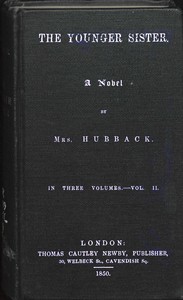
The Younger Sister: A Novel, Vol. II. — Themes and Context can be approached with a clearer sense of reading commitment from its source measurements: 72,280 words, 5 hr 15 min estimated reading time, and 15 detected text sections.
The text analysis averages about 25.8 words per sentence, while the detected sections provide another way to judge how the source is divided.
Project Gutenberg metadata also associates the work with “England -- Fiction,” connecting these edition facts with the source record’s subject description.
Explore this collection
These alternatives are selected using recorded categories and estimated reading time.
About 325 minutes
Classic Romance
74,525 recorded words. 10 minutes difference from this book's estimate.
View Gutenberg source #41031About 326 minutes
Classic Romance
74,859 recorded words. 11 minutes difference from this book's estimate.
View Gutenberg source #67979About 328 minutes
Classic Romance
75,412 recorded words. 13 minutes difference from this book's estimate.
View Gutenberg source #13396Search stored excerpts and compare books → Choose by your preferences →
Choices use stored catalog measurements. Estimates vary with reading speed. A shared category is a catalog label, not a claim that two books have the same argument or literary quality.
Search reads excerpt text stored with this catalog and links to its associated Gutenberg record. The connection is stored in the site database; this tool does not recheck that every excerpt is word-for-word identical to that external record. Excerpt search does not cover every chapter and does not verify historical publication dates.
Catalog snapshot checked: 2026-09-26. Coverage: 89 public books, 89 available source excerpts.
Calculated from edition completeness, EPUB availability, text structure and catalogue metadata. Not a user rating.
Total of 100 points, scaled to a 2.5-5.0 range. Editions with an empty description or a missing EPUB file are not scored.
Public-domain source text
The source text is kept in the dedicated reader, separate from this catalogue record and its commentary.
Volume II of The Younger Sister opens with a ten-day wait for an important party, a delay that sets the household in a state of alternating hope and irritation. The narrative moves swiftly between rooms—the father's chamber, the hall, the nursery—each space carrying its own emotional temperature. The sudden arrival of a post-chaise disrupts the domestic routine, and the ensuing commotion is rendered through a cacophony of laughter and overlapping voices, a technique that recurs throughout the volume to signal shifts in mood.
The novel's structure relies on intervals of anticipation. The ten-day gap before the party is not merely a plot device but a framework for exploring how characters inhabit time. Margaret's temper oscillates between pleasure and acidity, her equanimity destroyed by minor dress difficulties. The household's emotional state is compared to the ebbing and flowing of the tide, yet the narrator notes that its recurrence cannot be calculated with certainty. This unpredictability is mirrored in the physical movement of characters: they are constantly pausing at staircases, turning corners, or lingering in hallways. Emma, for instance, pauses at the turn of the stairs to observe the scene below, a moment that emphasizes her position as both participant and observer. The architecture of the house—stairs, doors, rooms—becomes a stage for these suspended moments, where characters wait for news, for letters, or for the next disruption.
Correspondence in this volume is never neutral. Letters are handled, examined, and withheld. Mrs. Watson detains Emma's letter, turning it over and holding it up to the light, unable to read its contents but unwilling to relinquish it. The seal—a coronet—provokes speculation about its sender. Jane Watson intercepts a letter addressed to her husband, suspecting it might be from a mistress. The act of reading is often deferred or obstructed: letters arrive in envelopes, frustrating those who wish to peek inside. This pattern of surveillance and secrecy extends to spoken exchanges. Margaret complains that Emma is “so close” about her thoughts regarding Lord Osborne, and the family resents her refusal to share confidences. The physical handling of letters—their weight, their seals, their franked envelopes—becomes a recurring image for the tension between openness and concealment that pervades the household.
The Watson home is a space of shifting allegiances. Characters move between rooms, forming temporary alliances that dissolve as quickly as they form. Margaret and Pen argue over who will sit with Emma; Mrs. Watson enlists Emma for sewing while simultaneously interrogating her about her letter. The nursery becomes a site of quiet resistance: Emma, finding Janetta asleep, prepares to write a letter of her own, only to be interrupted by a request for alterations to a bombazine gown. The domestic labor of women—sewing, letter-writing, childcare—is woven into the narrative, but it is never allowed to proceed without interruption. The constant movement between rooms—from the drawing-room to the office, from the nursery to the stair-case window—creates a rhythm of intrusion and retreat. The novel's structure mirrors this restlessness, as scenes are cut short by the arrival of new characters or the discovery of new letters.
The dialogue in Volume II is marked by a distinctive cacophony. The narrator describes a “mingled clatter of tongues, which might almost be denominated screaming,” and this auditory texture recurs throughout. Characters speak over one another, their voices overlapping in hallways and drawing-rooms. Margaret's shrill exclamation rouses her father from a doze; Jane Watson's suspicions are voiced in a rapid, defensive stream. The effect is one of constant noise, a domestic soundscape that contrasts with the quiet of Emma's corner. The novel's structure often alternates between these noisy, crowded scenes and moments of solitude—Emma in her father's room, or alone with a letter. This alternation creates a rhythm of tension and release, as the reader moves from the clatter of family life to the relative stillness of individual reflection. The voice of the narrator remains detached, observing the chaos with a dry precision that underscores the absurdity of the household's intrigues.
Readers attentive to the novel's spatial and auditory details will find that the movement between rooms and the handling of letters offer a subtle commentary on the constraints of domestic life. The volume's structure—built on intervals of waiting and sudden disruptions—invites a reading that attends to the rhythms of interruption and the weight of unspoken thoughts.
There’s a certain quiet ache in how Mrs. Hubback’s letters move between drawing-rooms and their hidden meanings, that lingering sense of what stays unsaid. It reminded me of another volume I once lost an afternoon to, where similar interiors hold their own weight. That same hush of private feeling. The Old Helmet, Volume I — Key Ideas to Explore carries it too, like a familiar room you’d forgotten.
Capture what you thought, learned, and would like to remember.