About 213 minutes
Holly: The Romance of a Southern Girl — Context and Discussion
Classic Romance
48,913 recorded words. 8 minutes difference from this book's estimate.
View Gutenberg source #69920
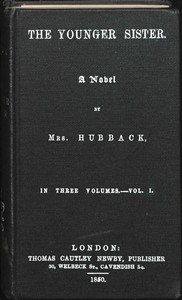
The Younger Sister: A Novel, Vol. I. — Context and Discussion can be approached with a clearer sense of reading commitment from its source measurements: 50,708 words, 3 hr 41 min estimated reading time, and 13 detected text sections.
The text analysis averages about 22.7 words per sentence, while the detected sections provide another way to judge how the source is divided.
Project Gutenberg metadata also associates the work with “England -- Fiction,” connecting these edition facts with the source record’s subject description.
Explore this collection
These alternatives are selected using recorded categories and estimated reading time.
About 213 minutes
Classic Romance
48,913 recorded words. 8 minutes difference from this book's estimate.
View Gutenberg source #69920About 196 minutes
Classic Romance
44,969 recorded words. 25 minutes difference from this book's estimate.
View Gutenberg source #49282About 246 minutes
Classic Romance
56,363 recorded words. 25 minutes difference from this book's estimate.
View Gutenberg source #71024Search stored excerpts and compare books → Choose by your preferences →
Choices use stored catalog measurements. Estimates vary with reading speed. A shared category is a catalog label, not a claim that two books have the same argument or literary quality.
Search reads excerpt text stored with this catalog and links to its associated Gutenberg record. The connection is stored in the site database; this tool does not recheck that every excerpt is word-for-word identical to that external record. Excerpt search does not cover every chapter and does not verify historical publication dates.
Catalog snapshot checked: 2026-09-26. Coverage: 89 public books, 89 available source excerpts.
Calculated from edition completeness, EPUB availability, text structure and catalogue metadata. Not a user rating.
Total of 100 points, scaled to a 2.5-5.0 range. Editions with an empty description or a missing EPUB file are not scored.
Public-domain source text
The source text is kept in the dedicated reader, separate from this catalogue record and its commentary.
Mrs. Hubback opens The Younger Sister with a measured, almost clinical account of Reverend John Watson's decline: his energy 'departed' with his wife's death, and his grief curdles into self-indulgence and gout. The narrative voice here is detached, summarizing years in a few paragraphs, yet it sharpens into irony when describing the daughters left 'to their own guidance and discretion, or indiscretion.' This tonal shift—from summary to pointed observation—recurs throughout the volume, especially in dialogue.
The dedication to Jane Austen signals a literary lineage, and the prose often echoes Austen's free indirect style, but Hubback's pacing is distinctive: she lingers on awkward social encounters, such as Tom Musgrove's intrusion, where the narrator's dry commentary and the characters' strained exchanges create a slow, uncomfortable rhythm.
The first chapter establishes a pattern of narrative distance: the Reverend Watson's history is delivered in broad, impersonal strokes—'he became indolent from sorrow; shunning society—shrinking from exertion.' Yet within the same paragraph, the voice contracts to a near-Austenian intimacy: 'his girls—at least, the three eldest—were left entirely to their own guidance and discretion, or indiscretion, to speak with more propriety.' The parenthetical correction ('to speak with more propriety') is a hallmark of the narrator's ironic complicity with the reader, a technique that surfaces intermittently throughout the volume.
This oscillation between summary and close observation governs the novel's pace. In later scenes, the narrator withdraws again, allowing dialogue to carry the weight. For instance, Mr. Watson's exchange with Tom Musgrove—'Well master Tom, what foolish thing have you been doing lately?'—is rendered almost entirely in direct speech, with minimal intervention. The effect is a sudden acceleration: the reader is thrust into the room, forced to parse the characters' tones and subtext without narrative mediation.
Dialogue in The Younger Sister often functions as a brake on narrative momentum. When Mr. Watson settles into his armchair, the scene slows to a crawl of social negotiation: Elizabeth's failed introduction, Mrs. Willis's soothing intervention, and Mr. Watson's complaint about the gout making it 'extremely difficult to move across the room.' The narrator's gloss—'Elizabeth did not think it necessary to justify herself'—is a rare moment of interiority, but the scene's pace is dictated by the characters' verbal fumbling.
Contrast this with Tom Musgrove's entrance, which injects a different rhythm. His banter with Mr. Watson—'breaking any more horses' knees or dinner-engagements'—is brisk and combative, and the narrator steps back to let the sparring unfold. Yet even here, the pace is uneven: Tom's boast about beating Lord Osborne at Fives is met with Mr. Watson's dry retort about gout, and the exchange stalls into a standoff. Hubback uses these conversational lurches to mirror the social discomfort that pervades the Watson household.
Three motifs recur across the excerpts, each tied to changes in narrative pace. First, gout: it is introduced as a consequence of indolence, then becomes a prop for Mr. Watson's self-pity and a weapon in dialogue ('When you have the gout in your foot even twice as bad as I have'). The word itself appears with rhythmic regularity, slowing scenes as characters pause to accommodate the sufferer.
Second, the concept of 'freedom'—Tom Musgrove's insistence on 'perfect freedom' from 'fire-side bonds'—is voiced in a rapid, almost manic burst, contrasting with the constrained domestic setting. Third, the act of looking: Mr. Watson 'took a survey of the room' before recognizing Emma; Elizabeth's introduction is thwarted by 'self-engrossment and bustle.' These visual cues punctuate the narrative, marking shifts in attention and power. Together, these motifs create a texture of physical and social limitation, against which the younger sister's quiet exertions—'Emma's exertions, at this time, were almost rendered useless'—stand out as a counterpoint of purposeful action.
The narrator's treatment of Mr. Watson is a study in controlled irony. His grief is initially presented as genuine—'prostrate his mental strength'—but the sentence structure undercuts him: 'This line of conduct, begun from grief... was continued from self-indulgence.' The parallel clauses mimic a rationalization that the narrator refuses to endorse. Later, his complaints about etiquette are rendered with a straight face, yet the context—Elizabeth's foiled introduction—reveals his self-absorption. The narrator never condemns outright; instead, the pacing of the prose—long, periodic sentences for his history, clipped dialogue for his present—creates a portrait of a man who has slowed down the world around him.
Emma, by contrast, is introduced through action rather than summary: 'Emma's exertions, at this time, were almost rendered useless by the zeal with which Mr. Howard seconded her movements.' The passive construction ('were almost rendered useless') and the ironic 'zeal' hint at a narrative sympathy that remains implicit. The reader must infer her character from these brief, almost buried observations.
Readers attentive to narrative voice will find The Younger Sister a study in controlled pace: the novel alternates between summary and scene, with dialogue often slowing to a crawl of social missteps. Pay particular attention to the narrator's parenthetical asides and the recurring motifs of gout and freedom—they are not mere decoration but structural devices that shape the reading experience. The volume ends mid-scene, leaving Emma's story suspended; the pacing of this first volume suggests a deliberate accumulation of tension rather than resolution.
There’s a particular ache in The Younger Sister, watching Emma navigate rooms where everyone’s speaking past her. It reminded me of another quiet heroine, tucked into a story about rank and longing. Some novels just hold that feeling—being on the outside of a conversation—like Her Serene Highness: A Novel — Story, Setting & Ideas, which lingers on similar, unspoken tensions. Odd how these echoes linger.
Use these questions to collect your thoughts before moving on.