About 889 minutes
Say and Seal, Volume II — A Reader’s Guide
Classic Romance
204,430 recorded words. 13 minutes difference from this book's estimate.
View Gutenberg source #28545
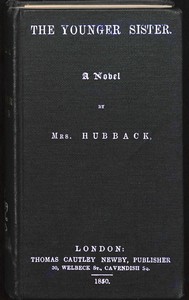
The source record for The Younger Sister: A Novel, Volumes 1-3 — Inside the Classic measures this digital text at 201,361 words, 14 hr 36 min estimated reading time, and 47 detected text sections.
The text analysis averages about 24.6 words per sentence, while the detected sections provide another way to judge how the source is divided.
Project Gutenberg metadata also associates the work with “England -- Fiction,” connecting these edition facts with the source record’s subject description.
Explore this collection
These alternatives are selected using recorded categories and estimated reading time.
About 889 minutes
Classic Romance
204,430 recorded words. 13 minutes difference from this book's estimate.
View Gutenberg source #28545About 736 minutes
Classic Romance
169,180 recorded words. 140 minutes difference from this book's estimate.
View Gutenberg source #5227About 634 minutes
Classic Romance
145,620 recorded words. 242 minutes difference from this book's estimate.
View Gutenberg source #24000Search stored excerpts and compare books → Choose by your preferences →
Choices use stored catalog measurements. Estimates vary with reading speed. A shared category is a catalog label, not a claim that two books have the same argument or literary quality.
Search reads excerpt text stored with this catalog and links to its associated Gutenberg record. The connection is stored in the site database; this tool does not recheck that every excerpt is word-for-word identical to that external record. Excerpt search does not cover every chapter and does not verify historical publication dates.
Catalog snapshot checked: 2026-09-26. Coverage: 89 public books, 89 available source excerpts.
Calculated from edition completeness, EPUB availability, text structure and catalogue metadata. Not a user rating.
Total of 100 points, scaled to a 2.5-5.0 range. Editions with an empty description or a missing EPUB file are not scored.
Public-domain source text
The source text is kept in the dedicated reader, separate from this catalogue record and its commentary.
Catherine-Anne Austen Hubback's The Younger Sister (1850) opens with the Reverend John Watson's decline after his wife's death, leaving his daughters motherless and unchecked. The novel, dedicated to Jane Austen, shares with its predecessor a keen eye for the social mechanics of courtship. But where Austen often lets irony speak through narrative distance, Hubback's narrator is more explicit: Margaret Watson's engagement is described as 'perfect ecstasy' because it allows her to 'sigh sentimentally' and bask in the distinction of being an engaged lady. The excerpts show a world where a proposal is less a private matter than a public performance, with neighbours scrutinising every detail from 'the colour of his hair' to 'the style of his equipage.'
The excerpts from Volume I, Chapter XI offer a sustained critique of how courtship functions as a social display. Margaret Watson's delight in her engagement is not rooted in affection for Tom Musgrove but in the 'distinction which all this would give her in a small country town.' Hubback's narrator catalogues the rituals of announcement: informing morning visitors, sighing over the prospect of leaving sisters, and introducing 'her dear Tom—her absent friend—on all occasions in her speeches.' The community reciprocates with intense scrutiny. Miss Jenkins is 'dying to see him'; Miss Lamb is certain he must be 'a charming beau'; Miss Morgan and her sister are 'never weary of hearing the colour of his hair, and the style of his equipage.' Yet this public validation comes with its own discomforts. Other young ladies 'shrugged their shoulders' and whispered about the courtship; Miss Lascomb finds it 'very odd indeed' that Mr. Musgrove does not visit. Hubback shows how the same social circle that elevates Margaret also undermines her, with 'kind friends' retailing every skeptical remark. The engagement becomes a performance that must be maintained against private doubt.
The catalog subjects list 'motherless families' and 'children of clergy,' and the opening chapter establishes this as a central condition. After Mrs. Watson's death, the Reverend Watson becomes 'indolent from sorrow,' shunning society and confining himself to minimal duties. His grief curdles into self-indulgence, and his daughters grow up 'with almost every disadvantage that could attend them.' The narrator is blunt: the three eldest girls are 'left entirely to th' (the excerpt cuts off, but the implication is clear). This neglect shapes their prospects. Margaret's eagerness for marriage is not simply vanity but a bid for status in a world where a woman's position depends on her husband. Rosa, in an earlier excerpt, voices a cynical theory: 'they are all tyrants to women at heart, only some wear a mask in courtship and some do not take that trouble.' The sisters navigate a system where marriage is both a necessity and a gamble, and the absence of maternal guidance leaves them to make their own—often flawed—calculations.
Hubback's narrator is more overtly judgmental than Austen's. Margaret's 'weak mind' and 'gratified vanity' are stated directly; her engagement makes her 'more than ever peevish and disagreeable to her sisters in private, and more affable and smiling to her associates in public.' The narrator does not let the reader infer the irony—she spells it out. This explicitness extends to the community's gossip. The 'many kind friends, who delighted in retailing small ware of the kind' are named as agents of social pressure. The novel's moral landscape is drawn in clear lines: vanity is punished, sincerity is rare, and the marriage market is a spectacle of self-deception. The dedication to Jane Austen invites comparison, but Hubback's technique is distinct—less subtle, more direct, and unafraid to label a character's motives. Readers expecting Austen's indirection will find a blunter, though still observant, moral commentator.
The excerpts suggest that The Younger Sister is less a romance than a study of courtship as a social transaction, driven by vanity, gossip, and economic necessity. Readers should attend to the narrator's explicit judgments and the way community scrutiny shapes the sisters' choices. The novel's length (over 200,000 words) allows for extensive development of these dynamics across multiple households. Those interested in mid-19th-century women's fiction and the shadow of Jane Austen will find here a work that borrows a familiar setting but applies a more direct moral lens.
Reading about Margaret’s vanity-driven engagement, I kept thinking of how public opinion can quietly replace our own voice. It reminded me of The Moth Decides: A Novel — Reading Notes, where a similar hesitancy lingers in the margins, almost like a half-finished sentence. Both feel less like stories and more like watching someone choose a stranger’s reflection over their own.
A brief reflection can help important ideas stay with you longer.