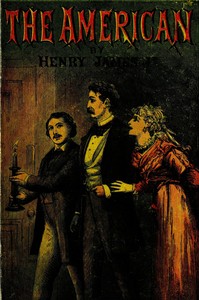
About 611 minutes
The American — Reading Companion
Family Stories
140,340 recorded words. 225 minutes difference from this book's estimate.
View Gutenberg source #177
Before opening The Egoist: A Comedy in Narrative — Context and Discussion, the edition data offers a quick orientation: 192,243 words, 13 hr 56 min estimated reading time, and 18 detected text sections.
The text analysis averages about 13.9 words per sentence, while the detected sections provide another way to judge how the source is divided.
Project Gutenberg metadata also associates the work with “England -- Fiction,” connecting these edition facts with the source record’s subject description.
Explore this collection
These alternatives are selected using recorded categories and estimated reading time.
About 611 minutes
Family Stories
140,340 recorded words. 225 minutes difference from this book's estimate.
View Gutenberg source #177About 572 minutes
Family Stories
131,504 recorded words. 264 minutes difference from this book's estimate.
View Gutenberg source #1342About 515 minutes
Family Stories
118,421 recorded words. 321 minutes difference from this book's estimate.
View Gutenberg source #3404Search stored excerpts and compare books → Choose by your preferences →
Choices use stored catalog measurements. Estimates vary with reading speed. A shared category is a catalog label, not a claim that two books have the same argument or literary quality.
Search reads excerpt text stored with this catalog and links to its associated Gutenberg record. The connection is stored in the site database; this tool does not recheck that every excerpt is word-for-word identical to that external record. Excerpt search does not cover every chapter and does not verify historical publication dates.
Catalog snapshot checked: 2026-09-26. Coverage: 89 public books, 89 available source excerpts.
Calculated from edition completeness, EPUB availability, text structure and catalogue metadata. Not a user rating.
Total of 100 points, scaled to a 2.5-5.0 range. Editions with an empty description or a missing EPUB file are not scored.
Public-domain source text
The source text is kept in the dedicated reader, separate from this catalogue record and its commentary.
George Meredith's The Egoist opens with a prelude that immediately establishes the narrator's distinctive voice. The Comic Spirit, we are told, 'hunts the spirit in men' and 'rejects all accessories in the exclusive pursuit of them and their speech.' This declaration shapes the novel's method: a close, ironic scrutiny of characters within the drawing-room, where social performance is paramount. The narrator's own language is playful and self-aware, as when he refers to 'the Book of Egoism' and humorously translates the 'notable humourist' on the need for compression. This is not a neutral storyteller but a witty commentator who invites the reader to 'follow and you will see.'
The prelude to The Egoist functions as a manifesto for Meredith's comic method. The narrator distinguishes comedy from realism, noting that it 'deals with human nature in the drawing-room of civilized men and women, where we have no dust of the struggling outer world.' This is a deliberate narrowing of focus: the comic spirit 'conceives a definite situation for a number of characters' and pursues 'the spirit in men' through their speech. The narrator's own voice is performative, full of elaborate metaphors—the 'big book' of egoism, the 'crow-scalp' of a solitary outsider—that signal a self-conscious artistry. The prelude thus primes the reader to attend to dialogue and gesture as the primary carriers of meaning, rather than plot or action.
In the storm scene from Chapter XXVI, Meredith employs free indirect discourse to render the thoughts of multiple characters without explicit attribution. When Willoughby 'suffered De Craye to go on his chance unaccompanied' and 'was near chuckling,' the narration slides into his perspective, revealing his manipulative hope. Similarly, De Craye's internal monologue—'Jove! he may be fond of her. But he's not on the track'—is presented without quotation marks, blending his voice with the narrator's. This technique allows the reader to gauge each character's self-interest and misreading of others. The effect is comic: each man believes he understands Clara's motives, yet their assumptions are shown to be partial and self-serving.
The storm in the excerpt is both a literal event and a symbolic reflection of emotional turmoil. The description of 'young-leaved trees' as 'steely black, without a gradation of green' and the rain's 'inveterate hiss' creates a hostile landscape that mirrors Clara's predicament. The ladies at the Hall 'exclaimed against Clara' for her 'wild' behavior, and the narrator notes 'how dark are trivial errors when circumstances frown.' The weather thus becomes a catalyst for judgment and a test of character: De Craye deduces that 'no storm would daunt her on a predetermined expedition,' while Willoughby's concern is more about controlling the narrative. The rain is not merely atmospheric but functional, driving the plot toward Clara's flight and the pursuit by Vernon and De Craye.
Meredith's dialogue is marked by its stylized, almost theatrical quality. When De Craye says, 'I chuck up my head like a halfpenny, and go by the toss,' the line is deliberately flippant, revealing his casual, gambling approach to life. Willoughby's response—'Which way do you take?'—is clipped and anxious, betraying his fear of losing control. The exchange is not naturalistic but heightened, each character performing a version of themselves. The narrator's interjections—'This enraging nonsense drove off Willoughby'—underscore the comic tension. Dialogue here is a weapon and a mask, and Meredith invites the reader to read between the lines for the unspoken calculations beneath the polished surface.
Readers approaching The Egoist should attend closely to the narrator's ironic asides and the subtle shifts in perspective. Meredith's comedy is not broad but precise, built on the gap between what characters say and what they reveal through their choices of words. The prelude's promise to 'throw reflections upon social life' is fulfilled in every scene, as egoism is exposed not through moralizing but through the very texture of conversation and description. Let the storm scene serve as a guide: watch for the weather, listen for the half-spoken thought, and trust the Comic Spirit to lead you.
There’s a particular comfort in watching Meredith dissect vanity with such a wry, forgiving hand—the storm in that scene feels less like punishment than a sigh. It reminded me of the quiet ache in The Lily of the Valley, where weather and longing share the same breath. The Lily of the Valley — Background and Themes lingers with me that way, soft and unresolved.
Use these questions to collect your thoughts before moving on.