About 316 minutes
Juggernaut: A Veiled Record — Story, Setting & Ideas
Marriage Society
72,621 recorded words. 4 minutes difference from this book's estimate.
View Gutenberg source #39922
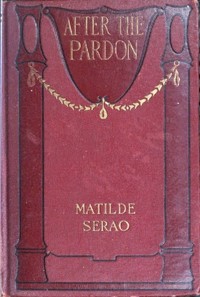
Before opening After the Pardon — Reading Notes, the edition data offers a quick orientation: 73,419 words, 5 hr 20 min estimated reading time, and 8 detected text sections.
The text analysis averages about 15.6 words per sentence, while the detected sections provide another way to judge how the source is divided.
Project Gutenberg metadata also associates the work with “Adultery -- Fiction,” connecting these edition facts with the source record’s subject description.
Explore this collection
These alternatives are selected using recorded categories and estimated reading time.
About 316 minutes
Marriage Society
72,621 recorded words. 4 minutes difference from this book's estimate.
View Gutenberg source #39922About 311 minutes
Marriage Society
71,314 recorded words. 9 minutes difference from this book's estimate.
View Gutenberg source #39172About 307 minutes
Marriage Society
70,438 recorded words. 13 minutes difference from this book's estimate.
View Gutenberg source #15402Search stored excerpts and compare books → Choose by your preferences →
Choices use stored catalog measurements. Estimates vary with reading speed. A shared category is a catalog label, not a claim that two books have the same argument or literary quality.
Search reads excerpt text stored with this catalog and links to its associated Gutenberg record. The connection is stored in the site database; this tool does not recheck that every excerpt is word-for-word identical to that external record. Excerpt search does not cover every chapter and does not verify historical publication dates.
Catalog snapshot checked: 2026-09-26. Coverage: 89 public books, 89 available source excerpts.
Calculated from edition completeness, EPUB availability, text structure and catalogue metadata. Not a user rating.
Total of 100 points, scaled to a 2.5-5.0 range. Editions with an empty description or a missing EPUB file are not scored.
Public-domain source text
The source text is kept in the dedicated reader, separate from this catalogue record and its commentary.
The novel opens with Donna Maria Guasco Simonetti reading alone, surrounded by cushions 'of all kinds of fabrics and colours,' a lamp casting 'opalised' light on her chestnut hair. The description dwells on textures—sheenless silver silk, fleecy lace, gold cloth shoes—establishing a world of refined domesticity. Yet the silence is broken only by the rustle of pages and a clock striking half-past nine. Maria starts slightly and murmurs, 'Always later, always...' The sentence trails off, hinting at a habitual solitude that frames the story.
Serao’s authorial choices in diction and description foreground interior states through external detail. Maria’s composed mouth 'without smile but without bitterness' suggests a deliberate emotional withholding. The opening tableau—a woman reading, alone, in a room of soft luxury—immediately signals a central tension between surface composure and unspoken currents.
The excerpted dialogue between Maria and Gianni Provana reveals Serao’s method of using conversation to expose power dynamics. Provana presses Maria for a reaction: 'You can’t bear me, isn’t it so?' She replies with monosyllables—'No,' 'Perhaps,' 'You are mistaken'—until he forces her to admit he is 'indifferent.' The word lands like a verdict. Provana’s response—'The worst you could have told me you have told'—shows how Serao lets a single word carry emotional weight.
Maria’s subsequent analysis of his motives is strikingly clinical: 'a question of self-love... you have begun to suffer because you can’t succeed with me.' She dissects his passion as a reflex of wounded vanity. The dialogue avoids melodrama; instead, it proceeds through logical escalation. Provana’s physical gestures—removing his monocle, kissing her hand—are noted but not dramatized. Serao prioritizes the verbal duel over sentimental cues.
Serao’s narrative voice often mirrors Maria’s detachment. When Provana asks if Emilio is 'an impassioned lover, an enamoured husband, and a tender friend,' Maria replies: 'None of these things... An enemy perhaps.' The triplet of expected roles is dismantled in two short sentences. The word 'perhaps' leaves room for ambiguity, but the structure is decisive.
Notice how Serao handles the concept of pardon. Maria says, 'He has pardoned me, yes. He has pardoned me, but nothing more.' The repetition of 'pardoned' underscores the gap between the act and its emotional reality. The phrase 'nothing more' becomes a refrain. Later, Maria states: 'I am humiliated and humiliate myself every day... But I can’t tell him to love me; neither does he ask it of me.' The parallel clauses—'I can’t tell him... neither does he ask'—create a stalemate. Serao’s syntax enacts the impasse.
Serao invests objects with psychological weight. Maria’s initial reading is accompanied by a 'tiny clock' that 'tinkled clearly,' marking time in a room where nothing else stirs. The clock reappears as a cue for her habitual solitude. Later, when Provana stays after others leave, Maria 'took a book with uncut leaves from a table, looked for a paper-knife, and, having found it, with the peculiar noise of cut paper, occupied her beautiful hands.' The action—cutting pages—is a deliberate avoidance of engagement. The 'peculiar noise' draws attention to the act itself, making it a performance of indifference.
The gold cloth shoes that 'peeped out' in the opening scene are 'slightly peculiar and bright, the caprice of a lady in her own home.' This detail, seemingly minor, hints at a private self that contrasts with the composed exterior. Serao uses such objects to suggest layers of personality that dialogue alone does not reveal.
The excerpts are dominated by Maria’s voice—measured, analytical, often self-aware. She speaks in complete sentences, rarely interrupted. When Provana says 'Alas, it is no supposition!' she cuts him off: 'Let us not speak of love... My greedy ears are satiated with it.' The metaphor of satiation ('greedy ears') is both vivid and distancing. She treats love as a discourse she has exhausted.
Yet silence also speaks. The foreword (by F.F.) describes the novel as showing 'how their passions force them beyond all laws and duties,' but the excerpts show characters who are acutely controlled. Maria’s pauses—'Always later, always...'—and Provana’s bitten lip suggest emotions that language cannot fully contain. Serao’s dialogue often leaves the unsaid as important as the said, creating a texture of restraint.
Readers attentive to Serao’s craft will notice how she builds tension through small verbal and physical details—a clock, a paper-knife, a hand kissed a moment too long. The excerpts offer a concentrated study of a marriage after crisis, where pardon has become a word without emotional force. The novel’s interest lies not in plot events but in the slow, precise erosion of intimacy through language and gesture.
There’s a weight in reading alone after a pardon that never quite reaches the other person, and that ache stayed with me long after After the Pardon. It made me think of how Love's bitterest cup — Inside the Classic holds that same quiet distance, the cold clarity of a love that survives its words but not its warmth. I still feel it sometimes.
A brief reflection can help important ideas stay with you longer.