About 320 minutes
After the Pardon — Reading Notes
Marriage Society
73,419 recorded words. 4 minutes difference from this book's estimate.
View Gutenberg source #50318
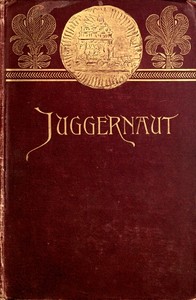
The source record for Juggernaut: A Veiled Record — Story, Setting & Ideas measures this digital text at 72,621 words, 5 hr 16 min estimated reading time, and 7 detected text sections.
The text analysis averages about 15.1 words per sentence, while the detected sections provide another way to judge how the source is divided.
Project Gutenberg metadata also associates the work with “Political fiction,” connecting these edition facts with the source record’s subject description.
Explore this collection
These alternatives are selected using recorded categories and estimated reading time.
About 320 minutes
Marriage Society
73,419 recorded words. 4 minutes difference from this book's estimate.
View Gutenberg source #50318About 311 minutes
Marriage Society
71,314 recorded words. 5 minutes difference from this book's estimate.
View Gutenberg source #39172About 307 minutes
Marriage Society
70,438 recorded words. 9 minutes difference from this book's estimate.
View Gutenberg source #15402Search stored excerpts and compare books → Choose by your preferences →
Choices use stored catalog measurements. Estimates vary with reading speed. A shared category is a catalog label, not a claim that two books have the same argument or literary quality.
Search reads excerpt text stored with this catalog and links to its associated Gutenberg record. The connection is stored in the site database; this tool does not recheck that every excerpt is word-for-word identical to that external record. Excerpt search does not cover every chapter and does not verify historical publication dates.
Catalog snapshot checked: 2026-09-26. Coverage: 89 public books, 89 available source excerpts.
Calculated from edition completeness, EPUB availability, text structure and catalogue metadata. Not a user rating.
Total of 100 points, scaled to a 2.5-5.0 range. Editions with an empty description or a missing EPUB file are not scored.
Public-domain source text
The source text is kept in the dedicated reader, separate from this catalogue record and its commentary.
The novel opens with a striking temporal dislocation: Edgar Braine, on the morning of his suicide, is described as 'never so blithe.' The narrative then leaps forward to recall that same June morning from a later point in his career, establishing a pattern of retrospective framing. The prose dwells on the 'photographic accuracy' of memory, a technique that recurs throughout the excerpts, where past moments intrude upon present action. This structural device—a future moment of crisis glimpsed before the story unfolds—creates a tension between the known outcome and the unfolding events, inviting readers to attend to the details that lead to that endpoint.
The excerpts are saturated with images of light and fire, used to mark emotional states and turning points. On the morning of his suicide, Braine walks in 'June sunshine all about him in a golden glory,' with an inner sunshine exceeding it. Later, in a Washington house, Helen Braine gazes 'steadily at the fire' while her husband kneels beside her. The fire becomes a silent witness to their strained intimacy. Braine’s speech about his schemes is delivered with 'fierce energy' and 'nervous fire,' linking his ambition to a consuming heat. These images are not merely decorative; they trace a trajectory from external brightness to internal conflagration, suggesting a progression from hope to a more dangerous intensity.
Physical gestures carry significant weight in the excerpts, often conveying what words leave unsaid. Braine takes Helen’s face 'between his hands' and drops 'on his knees by the side of her chair.' Her hands slip from his shoulders to her lap, where he clasps them 'gently.' These repeated touches—hands, faces, kneeling—create a choreography of intimacy that contrasts with the verbal content. Helen’s 'steady scrutiny' and 'abstraction' suggest a withdrawal that Braine’s caresses cannot bridge. The narrative lingers on these moments of physical contact, making them focal points where the emotional distance between the characters becomes palpable. The body, in these scenes, becomes a record of the marriage’s unspoken strains.
The structure of the excerpts alternates between interior, domestic spaces and the broader world of ambition. The opening scene is set on a 'cottonwood-bordered street' in a 'little Western city,' a public thoroughfare. Later, the action moves to a 'Washington house,' where Braine is 'absorbingly occupied with schemes of business and politics.' The private moments—the hotel room, the dressing room—are framed as respites from this public drive. Helen’s diary-like reflections reveal her anxiety about 'social success' and her fear of failing him in the coming season. This oscillation between the intimate and the social is not merely a setting detail; it structures the narrative’s rhythm, suggesting that the marriage is perpetually caught between personal connection and the demands of a public career.
The subtitle 'A Veiled Record' hints at a narrative that withholds as much as it reveals. The excerpts offer glimpses of a marriage under pressure, but the full nature of the conflict remains obscured. Helen’s internal monologue—'I have a terrible fear that I must fail him'—is juxtaposed with Braine’s confident declarations: 'This winter will decide all.' The reader is given access to both perspectives, yet the gaps between them—what each character does not say—are as significant as the spoken words. The novel’s structure, with its flashbacks and shifts in focalization, mirrors this veiling effect, inviting readers to piece together the record from fragments. This technique aligns with the catalog subject of 'Marriage & Society,' suggesting a critique of the social forces that shape private lives.
Readers attentive to the novel’s structure will notice how the opening’s promise of a suicide colors every subsequent scene, turning even moments of apparent joy into preludes to disaster. The recurring images of light and fire, the choreographed physical gestures, and the movement between private and public spaces all contribute to a portrait of a marriage under the pressure of ambition. The excerpts do not reveal the full arc of the story, but they establish a pattern of tension that rewards close attention to detail.
Reading about the marriage straining toward social ascent, I remembered evenings when my mother would polish the silver while my father studied blueprints—each gesture a silent negotiation. That domestic hush, thick with unspoken ambition, returns in Juggernaut’s firelight scenes. Once, Love's bitterest cup — Inside the Classic gave me the same ache, two people holding hands over a chasm they’d built themselves. Light and reach, always reaching.
Answer a few questions and save a private reflection on this device.