About 169 minutes
The Heart of Hyacinth — A Closer Reading
Romantic Drama
38,855 recorded words. 2 minutes difference from this book's estimate.
View Gutenberg source #63653
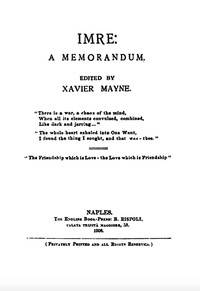
For Imre: A Memorandum — Inside the Classic, the stored edition analysis reports 39,302 words, 2 hr 51 min estimated reading time, and 4 detected text sections.
The text analysis averages about 15.0 words per sentence, while the detected sections provide another way to judge how the source is divided.
Project Gutenberg metadata also associates the work with “Love stories,” connecting these edition facts with the source record’s subject description.
Explore this collection
These alternatives are selected using recorded categories and estimated reading time.
About 169 minutes
Romantic Drama
38,855 recorded words. 2 minutes difference from this book's estimate.
View Gutenberg source #63653About 179 minutes
Romantic Drama
40,996 recorded words. 8 minutes difference from this book's estimate.
View Gutenberg source #29278About 181 minutes
Romantic Drama
41,602 recorded words. 10 minutes difference from this book's estimate.
View Gutenberg source #57099Search stored excerpts and compare books → Choose by your preferences →
Choices use stored catalog measurements. Estimates vary with reading speed. A shared category is a catalog label, not a claim that two books have the same argument or literary quality.
Search reads excerpt text stored with this catalog and links to its associated Gutenberg record. The connection is stored in the site database; this tool does not recheck that every excerpt is word-for-word identical to that external record. Excerpt search does not cover every chapter and does not verify historical publication dates.
Catalog snapshot checked: 2026-09-26. Coverage: 89 public books, 89 available source excerpts.
Calculated from edition completeness, EPUB availability, text structure and catalogue metadata. Not a user rating.
Total of 100 points, scaled to a 2.5-5.0 range. Editions with an empty description or a missing EPUB file are not scored.
Public-domain source text
The source text is kept in the dedicated reader, separate from this catalogue record and its commentary.
The book is framed as a memorandum addressed to an editor named Mayne, a device that immediately signals a confessional, private tone. The narrator, Oswald, writes from Velencze, Hungary, and insists that the dialogue is kept "word for word, faithfully as it passed" and that correspondence is "literally translated." This claim to verbatim accuracy sets up the work as a document of record, not a fictionalized romance. The prefatory letter also reveals the book's intended audience: "other men" who feel themselves in rebellion against "the narrow psychologic conventions" of the era. The structure is openly signaled by the table of contents, which divides the narrative into four parts: "Masks," "Masks and—A Face," and "Faces—Hearts—Souls." The progression from plural masks to a singular face to the triad of faces, hearts, and souls suggests a movement from concealment toward revelation, from social performance to inner truth.
The memorandum form is not merely a framing device but an organizing principle. Oswald writes to Mayne as a trusted confidant, yet the text is simultaneously offered to any "perplexed and solitary soul." This dual address—private yet public—creates a tension that runs through the entire work. The narrative is retrospective, written after the events it describes, and Oswald admits that "autobiography is likely to" lengthen under his hand. He struggles to maintain "the perspectives, and what painters call the values," a metaphor drawn from visual art that hints at the difficulty of rendering emotional truth in linear prose. The book's four-part structure mirrors this struggle: each section title marks a stage in the unmasking, from the general condition of wearing masks to the specific encounter with a face, and finally to the integration of faces, hearts, and souls. The reader is thus guided along a deliberate path from social disguise to intimate recognition.
The epigraphs establish a motif of internal conflict: "There is a war, a chaos of the mind, / When all its elements convulsed, combined." This language of convulsion and combination recurs in the narrator's description of his own nature. He speaks of a "master-instinct unsuspected by society" and describes the homosexual as "the extreme of the male," a paradoxical figure who is "super-male" yet socially condemned. The imagery of battle extends to the social realm: the narrator refers to "the ignoramus and the vulgar" who mistake homosexuals for hermaphrodites, and he invokes a history of men who "plough the globe's roughest seas," "rule its States," and "fight in the bravest ranks of its armies." These martial and laborious images serve to assert a virility that the dominant culture denies. The recurring phrase "the man-loving man" becomes a refrain, hammered out in short, emphatic clauses that mimic the rhythm of a manifesto.
Throughout the excerpts, the physical body is a site of both anxiety and assertion. Oswald insists that homosexual men bear "not one" openly womanish trait: "In every feature and line and sinew and muscle, in every movement and accent and capability, we walk the world's ways as men." This catalog of body parts—feature, line, sinew, muscle—is a rhetorical inventory designed to counter the stereotype of effeminacy. Yet the body also betrays the speaker: he describes a "shudder" at a woman's touch, a physical revulsion that he may not fully understand. The embrace between men is imagined as "a fusion that no woman's arms, no woman's kisses can ever realize." The word "fusion" suggests a merging that is both spiritual and physical, a union that transcends mere friendship. The narrator's language oscillates between clinical detachment ("homosexualism," "sexual passion") and visceral intensity ("the whole heart exhaled into One Want"), reflecting the split between public and private selves that the book seeks to heal.
The excerpts do not provide continuous narrative, but the structure implies a progression from public to private spaces. The prefatory letter is dated from Velencze, a lakeside resort, suggesting a retreat from the city. The main narrative likely begins in Budapest, as indicated by the catalog subject "Budapest (Hungary) -- Fiction." The movement from the Hungarian capital to a rural or small-town setting mirrors the inward journey from social masking to personal revelation. The dialogue passages are intense, almost theatrical, with long speeches that read like monologues. The narrator's outburst—"And yet, Imre, thousands, thousands, hundreds of thousands, of such human creatures as I am"—is addressed directly to Imre, the titular character, and shifts the register from general argument to personal appeal. This alternation between abstract reasoning and intimate address gives the prose a restless energy, as if the speaker is constantly testing the boundaries of what can be said aloud.
Readers should attend to the way the book uses its four-part structure to build toward a moment of full disclosure. The titles of the sections are not merely decorative; they map a psychological journey from concealment to authenticity. The memorandum form, with its claim to literal transcription, invites the reader to weigh the reliability of memory and the ethics of confession. The recurring imagery of war, the body, and the mask rewards close attention to language. This is a work that asks to be read not as a simple romance but as a deliberate, self-conscious act of testimony.
I finished Imre: A Memorandum and kept thinking about how slowly trust can surface between strangers. That same quiet unfolding lives in The Quest: A Romance — Inside the Classic, where hidden layers pull back gently over time. Some books feel like secrets whispered between friends. This one stayed with me, soft and unhurried, like a conversation we never quite ended.
Capture what you thought, learned, and would like to remember.