About 169 minutes
The Heart of Hyacinth — A Closer Reading
Romantic Drama
38,855 recorded words. 18 minutes difference from this book's estimate.
View Gutenberg source #63653
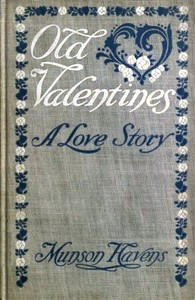
Old valentines — Story, Setting & Ideas can be approached with a clearer sense of reading commitment from its source measurements: 34,535 words, 2 hr 31 min estimated reading time, and 4 detected text sections.
The text analysis averages about 12.7 words per sentence, while the detected sections provide another way to judge how the source is divided.
Project Gutenberg metadata also associates the work with “Orphans -- Fiction,” connecting these edition facts with the source record’s subject description.
Explore this collection
These alternatives are selected using recorded categories and estimated reading time.
About 169 minutes
Romantic Drama
38,855 recorded words. 18 minutes difference from this book's estimate.
View Gutenberg source #63653About 171 minutes
Romantic Drama
39,302 recorded words. 20 minutes difference from this book's estimate.
View Gutenberg source #66390About 179 minutes
Romantic Drama
40,996 recorded words. 28 minutes difference from this book's estimate.
View Gutenberg source #29278Search stored excerpts and compare books → Choose by your preferences →
Choices use stored catalog measurements. Estimates vary with reading speed. A shared category is a catalog label, not a claim that two books have the same argument or literary quality.
Search reads excerpt text stored with this catalog and links to its associated Gutenberg record. The connection is stored in the site database; this tool does not recheck that every excerpt is word-for-word identical to that external record. Excerpt search does not cover every chapter and does not verify historical publication dates.
Catalog snapshot checked: 2026-09-26. Coverage: 89 public books, 89 available source excerpts.
Calculated from edition completeness, EPUB availability, text structure and catalogue metadata. Not a user rating.
Total of 100 points, scaled to a 2.5-5.0 range. Editions with an empty description or a missing EPUB file are not scored.
Public-domain source text
The source text is kept in the dedicated reader, separate from this catalogue record and its commentary.
The story of Old Valentines begins not with its orphaned heroine, Phyllis, but with a choice of entrances: the stage door or the main entrance. The narrator prefers the latter, and so introduces Sir Peter Oglebay, a man defined by his passion for construction and his identity as an English gentleman. His portrait is by Sargent, his monograph on the Egyptian Pyramids is dedicated to the British Engineering Society, and his library is filled with the somber Transactions of learned societies. Yet the narrative quickly shifts to a second, contrasting figure: Mr. Rowlandson, the bookseller, whose shop is a labyrinth of old and new volumes, where a gray cat named Selima stretches in a desk drawer. These two settings—the grand house in Armytage Street and the cluttered bookshop—establish the novel's central tension between the monumental and the intimate, the engineered and the organic.
The opening chapters present two distinct spheres. Sir Peter Oglebay's world is one of massive machinery, calculated accuracy, and dignified boards of directors. His library, filled with Proceedings and missing volumes, defines his chief interest. In contrast, Mr. Rowlandson's shop is a place of serendipity and personal connection. The bookseller knows his stock intimately, often misplacing volumes but always finding them again. He recommends Barrie's Margaret Ogilvy to casual customers and has sold over four hundred copies. He treasures a half-promise from Mr. Hewlett to write a novel about François Villon. The shop's odor of old books is a cultivated taste. When the long-sought Proceedings of the British Engineering Society for the Year 1848 finally arrives from Brussels, Mr. Rowlandson exclaims, "My me! My me!" and notes that Sir Peter will be pleased. This moment links the two worlds, but the bookshop remains a realm of warmth and idiosyncrasy, where a cat's ablutions predict customers.
Phyllis, the orphaned daughter of the actress Valentine Germain and the painter Robert Oglebay, enters the story hesitantly. She appears at Mr. Rowlandson's door in a brown coat and hat, carrying a parcel, and addresses him timidly. He recognizes her as Mrs. Landless, though she has not seen him before. She has heard of him from Farquharson and has come to see the pretty things in his rooms. The scene is understated, but it places Phyllis at the threshold of the bookshop's world. The narrative has already hinted at her lineage—her mother was the beautiful Valentine Germain—but the excerpts do not reveal her motives or the contents of her parcel. What is clear is that she is a figure of quiet uncertainty, stepping into a space that is both unfamiliar and welcoming. The bookshop, with its double-breasted shelves and hidden volumes, becomes a setting where her story may unfold, though the full shape of that story remains, like the missing Proceedings, yet to be discovered.
The bookshop is described with a loving attention to detail that suggests its importance beyond mere setting. The shelves are overweighted, the books stand double-breasted, and Mr. Rowlandson's knowledge is both encyclopedic and fallible. He can locate Otway behind the set of English Men of Letters or behind the old dramatists, but he sometimes sells a volume and forgets. The shop's clientele is diverse, and the moderns—Thackeray, Dickens, Meredith, Carlyle—sit alongside the old. Mr. Rowlandson's judgments are pointed: De Morgan is "too late"; Conrad is shelved next to Stevenson "significantly." This is a world where books are not just objects but carriers of relationships and promises. The half-promise from Mr. Hewlett, the letter to Barrie's publishers, the standing advertisement for the missing volume—all speak to a network of connections that extend beyond the shop. When Phyllis arrives, she steps into this network, and the novel suggests that her story, too, will be woven from such threads: old valentines, perhaps, or the bonds between people that books can symbolize.
Readers attentive to the interplay of setting and character will find in Old Valentines a narrative that values the specific over the generic. The engineering society's Proceedings and the bookseller's banter are not mere decoration; they are the texture of a world where human connection is forged through shared interests and quiet acts. As the story moves between Sir Peter's construction sites and Mr. Rowlandson's alcove, watch for how the objects—a missing volume, a parcel, a cat—become catalysts for the relationships that define the novel's heart.
There’s something tender in how Phyllis moves between Sir Peter’s ordered lines and Mr. Rowlandson’s quiet shelves—two worlds that don’t quite fit, yet hold her gently. It reminded me of the soft ache in The Wishing Moon — Context and Discussion, where longing lingers like a half-remembered dream. That feeling stayed with me long after I set both down. Warm, really.
Save your reaction, strongest insight, and memorable passage.