About 230 minutes
Judith Moore; or, Fashioning a Pipe — Edition Insights
Romantic Drama
52,862 recorded words. 8 minutes difference from this book's estimate.
View Gutenberg source #58876
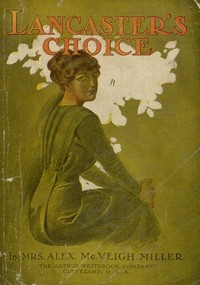
For Lancaster's Choice — Context and Discussion, the stored edition analysis reports 54,614 words, 3 hr 58 min estimated reading time, and 7 detected text sections.
The text analysis averages about 13.5 words per sentence, while the detected sections provide another way to judge how the source is divided.
Project Gutenberg metadata also associates the work with “Inheritance and succession -- Fiction,” connecting these edition facts with the source record’s subject description.
Explore this collection
These alternatives are selected using recorded categories and estimated reading time.
About 230 minutes
Romantic Drama
52,862 recorded words. 8 minutes difference from this book's estimate.
View Gutenberg source #58876About 260 minutes
Romantic Drama
59,717 recorded words. 22 minutes difference from this book's estimate.
View Gutenberg source #37528About 261 minutes
Romantic Drama
59,934 recorded words. 23 minutes difference from this book's estimate.
View Gutenberg source #19861Search stored excerpts and compare books → Choose by your preferences →
Choices use stored catalog measurements. Estimates vary with reading speed. A shared category is a catalog label, not a claim that two books have the same argument or literary quality.
Search reads excerpt text stored with this catalog and links to its associated Gutenberg record. The connection is stored in the site database; this tool does not recheck that every excerpt is word-for-word identical to that external record. Excerpt search does not cover every chapter and does not verify historical publication dates.
Catalog snapshot checked: 2026-09-26. Coverage: 89 public books, 89 available source excerpts.
Calculated from edition completeness, EPUB availability, text structure and catalogue metadata. Not a user rating.
Total of 100 points, scaled to a 2.5-5.0 range. Editions with an empty description or a missing EPUB file are not scored.
Public-domain source text
The source text is kept in the dedicated reader, separate from this catalogue record and its commentary.
The first chapter of Lancaster's Choice introduces a conflict rooted in money and control: Old Lady Lancaster, a wealthy widow, threatens to withhold her fortune unless her nephew, Clive Lancaster, marries according to her wishes. The narrator immediately establishes the stakes by noting that the title and estates are “a barren honor” without funds, and that Clive himself “did not dream of anything but obedience.” This opening efficiently sets up a classic romantic dilemma—duty versus desire—while also hinting at the heroine's eventual role as an obstacle to the aunt's plan.
The opening excerpt foregrounds Lady Lancaster’s financial power: she has “twenty thousand pounds a year of her own” and is determined to control her nephew’s marriage. The narrator’s phrasing—“she shook her gray head ominously, not to say viciously”—gives the aunt a sharp, almost comic edge. Readers are told that no one doubts Clive will obey, yet the very insistence on his compliance creates suspense. The excerpt also reveals that Clive remains in the army and that Lady Lancaster “reigned lady paramount” at his home, suggesting a power imbalance that the story will likely test.
In Chapter XXIV, the heroine Leonora gazes into a lake and sees Clive’s face reflected beside her own. The narrator calls this “the face of her fate” and describes the moment as a “Land of Enchantment.” The passage relies on sensory details—cigar smoke, a willow branch, nightingale song—to build an atmosphere of romantic illusion. When Clive breaks the spell by touching her, Leonora reacts with indignation: “How dared you? oh, how dared you?” Her anger is not coy; she explicitly accuses him of insulting her because she is “only the housekeeper’s niece.” This exchange reveals class consciousness and a heroine who will not passively accept advances.
Leonora’s response to Clive’s kiss is unusually forceful for a romantic heroine of the period. She does not swoon or blush; she demands, “what cause had I given you to—to think that your caresses could be agreeable to me?” The narrator notes that “all the Lancaster pride flushed into his face” at her rebuke, suggesting that the power dynamic between them is more complex than a simple lord-and-servant hierarchy. The excerpt leaves the outcome of this confrontation unresolved, but it establishes Leonora as a character who will challenge Clive’s assumptions and, by extension, the aunt’s control over his choice.
The provided excerpts cover only the first chapter and one later scene, so the overall plot remains unclear. However, the recurrence of water imagery—the “mystic pool” and “enchanted pool”—suggests that reflection and illusion may be thematic motifs. The title Lancaster’s Choice implies that Clive will eventually have to decide between his aunt’s money and his own desires, and Leonora’s defiance in the lake scene positions her as a likely catalyst for that choice. Readers should watch for how the aunt’s ultimatum and the heroine’s pride interact as the story unfolds.
These excerpts offer a focused entry point into a romance built on financial coercion and personal pride. The opening establishes the aunt’s will as the central obstacle, while the lake scene introduces a heroine who refuses to be treated as a subordinate. Readers may find it useful to track how Leonora’s sense of social position evolves and whether Clive’s “choice” ultimately reconciles love with the demands of inheritance.
That gray afternoon, the rain against the window made the quiet ambition of Miller’s heroine feel almost audible, a small struggle mirrored in the shallow water she kept gazing into. Afterwards, I found myself thinking how different that reflective tension was from the salt-air longing in Rose à Charlitte — Background and Themes, a place where the coast itself seemed to hold its breath. One book simply led to the other, like wet streets.
A brief reflection can help important ideas stay with you longer.