About 261 minutes
The Lady Paramount — Context and Discussion
Romantic Drama
59,934 recorded words. 1 minutes difference from this book's estimate.
View Gutenberg source #19861
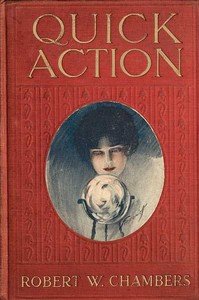
The source record for Quick Action — A Reader’s Guide measures this digital text at 59,717 words, 4 hr 20 min estimated reading time, and 10 detected text sections.
The text analysis averages about 14.0 words per sentence, while the detected sections provide another way to judge how the source is divided.
Project Gutenberg metadata also associates the work with “Love stories,” connecting these edition facts with the source record’s subject description.
Explore this collection
These alternatives are selected using recorded categories and estimated reading time.
About 261 minutes
Romantic Drama
59,934 recorded words. 1 minutes difference from this book's estimate.
View Gutenberg source #19861About 238 minutes
Romantic Drama
54,614 recorded words. 22 minutes difference from this book's estimate.
View Gutenberg source #47685About 287 minutes
Romantic Drama
65,885 recorded words. 27 minutes difference from this book's estimate.
View Gutenberg source #60983Search stored excerpts and compare books → Choose by your preferences →
Choices use stored catalog measurements. Estimates vary with reading speed. A shared category is a catalog label, not a claim that two books have the same argument or literary quality.
Search reads excerpt text stored with this catalog and links to its associated Gutenberg record. The connection is stored in the site database; this tool does not recheck that every excerpt is word-for-word identical to that external record. Excerpt search does not cover every chapter and does not verify historical publication dates.
Catalog snapshot checked: 2026-09-26. Coverage: 89 public books, 89 available source excerpts.
Calculated from edition completeness, EPUB availability, text structure and catalogue metadata. Not a user rating.
Total of 100 points, scaled to a 2.5-5.0 range. Editions with an empty description or a missing EPUB file are not scored.
Public-domain source text
The source text is kept in the dedicated reader, separate from this catalogue record and its commentary.
The preface of Quick Action announces itself as a contribution to “scientific investigation,” specifically the “science of Crystal Gazing,” and lists its tools as “crystals, playing cards, cigarettes, soiled pink wrappers, and the Police.” This deadpan humor sets an ironic tone that carries into the novel proper. The story opens with a will that pits two strangers—Johnson Gray and Constance Leslie—against each other for ownership of a coquina quarry. Their first meeting, excerpted here, is a study in clipped dialogue and mutual suspicion, played out on a beach where they pour sand through their fingers and trade barbs about the deceased testator’s “sense of humour.”
Chambers’s preface is a deliberate misdirection. It promises a serious study of crystal gazing, then undercuts itself with a list of mundane objects. The Latin tag Amor nihil est celerius! (“Nothing is swifter than love”) hints at the romantic plot while the preface’s mock-scholarly tone primes the reader for a narrative that will treat its own melodrama with a wink. This ironic framing is not sustained throughout—the main text shifts to a more conventional romantic comedy—but it establishes Chambers’s willingness to play with reader expectations.
The excerpted scene between Gray and Constance is built on rapid, symmetrical exchanges. Each character mirrors the other’s phrasing: “Where is your bungalow?” / “Mine is situated at the west end of a coquina quarry. Where is yours?” / “Mine … on the eastern edge.” The repetition creates a verbal standoff, emphasizing their equal footing and mutual distrust. Chambers uses short, declarative sentences (“The quarry belongs to me.”) and interruptions (“Yes, I do!”) to convey tension without lengthy description. The dialogue carries the burden of characterization: Gray laughs easily, Constance is “unsteady but defiant.” Their sparring over the will’s humor reveals contrasting temperaments—he finds it funny, she does not—while the shared predicament binds them.
The Florida island setting is sketched through discomfort: tarantulas, centipedes, scorpions, and a “most horrid bungalow” near a coquina quarry. Both characters chose the same quarry edge independently, a coincidence that strains credulity but serves the plot’s symmetry. The mention of ghosts—Constance recoils at the hint—adds a gothic undercurrent to the otherwise sunlit beach scene. Chambers does not linger on landscape; instead, he uses it as a backdrop for the characters’ isolation and vulnerability. The quarry itself, a source of potential wealth, becomes a contested space that forces Gray and Constance into proximity, setting the stage for the romantic drama promised by the catalog subjects.
Readers should attend to the shifts in tone between the preface’s satire and the main narrative’s earnest romantic comedy. Chambers’s voice is most distinctive in dialogue, where characters reveal themselves through verbal fencing. The excerpts suggest a novel that balances irony with sentiment, and the unfinished will plot leaves open how the quarry dispute will resolve. Pay attention to how the early symmetry between Gray and Constance evolves—or breaks—as the story progresses.
I keep thinking about that coquina quarry in Quick Action, how two strangers circled each other over an inheritance. There’s a similar quiet stubbornness in The Lady Paramount, the way property becomes a mirror for how we resist connection. Strange how stone and sand can hold such tenderness. The Lady Paramount — Context and Discussion surfaced this morning, and I lingered on it, like turning a familiar shell in my palm.
Answer a few questions and save a private reflection on this device.