About 261 minutes
The Lady Paramount — Context and Discussion
Romantic Drama
59,934 recorded words. 26 minutes difference from this book's estimate.
View Gutenberg source #19861
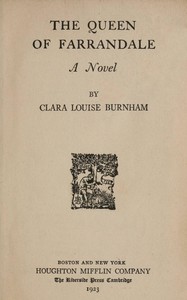
For The Queen of Farrandale: A Novel — Reading Notes, the stored edition analysis reports 65,885 words, 4 hr 47 min estimated reading time, and 8 detected text sections.
The text analysis averages about 12.5 words per sentence, while the detected sections provide another way to judge how the source is divided.
Project Gutenberg metadata also associates the work with “Love stories,” connecting these edition facts with the source record’s subject description.
Explore this collection
These alternatives are selected using recorded categories and estimated reading time.
About 261 minutes
Romantic Drama
59,934 recorded words. 26 minutes difference from this book's estimate.
View Gutenberg source #19861About 313 minutes
Romantic Drama
71,864 recorded words. 26 minutes difference from this book's estimate.
View Gutenberg source #71761About 260 minutes
Romantic Drama
59,717 recorded words. 27 minutes difference from this book's estimate.
View Gutenberg source #37528Search stored excerpts and compare books → Choose by your preferences →
Choices use stored catalog measurements. Estimates vary with reading speed. A shared category is a catalog label, not a claim that two books have the same argument or literary quality.
Search reads excerpt text stored with this catalog and links to its associated Gutenberg record. The connection is stored in the site database; this tool does not recheck that every excerpt is word-for-word identical to that external record. Excerpt search does not cover every chapter and does not verify historical publication dates.
Catalog snapshot checked: 2026-09-26. Coverage: 89 public books, 89 available source excerpts.
Calculated from edition completeness, EPUB availability, text structure and catalogue metadata. Not a user rating.
Total of 100 points, scaled to a 2.5-5.0 range. Editions with an empty description or a missing EPUB file are not scored.
Public-domain source text
The source text is kept in the dedicated reader, separate from this catalogue record and its commentary.
The novel opens with a scene in a noisy near-beer joint, where Hugh Sinclair, a young war veteran, meets John Ogden, an older family friend. The setting—a cheap restaurant with a brazen automatic piano—immediately establishes Hugh's rootlessness and the social gulf between the two men. Burnham uses the contrast between the clattering piano and the quiet hotel lobby they later seek to signal shifts in mood and conversation. Throughout the excerpts, such movement between public and private spaces recurs: from the restaurant to the hotel, from Ross Graham's store to Miss Frink's home. These transitions often coincide with revelations about character or plot, as when Ogden's casual mention of Hugh's sister Carol triggers a chain of memories and suspicions.
The name 'Carol' appears repeatedly, functioning as a kind of emotional lodestone. Hugh's sister Carol is first mentioned in the opening chapter, and later Miss Frink, upon hearing the name, reacts with 'unconscious fixedness' and the thought 'His mother's name was Carol.' This echo suggests a hidden connection between the two women. Burnham does not explain the link immediately; instead, she lets the name accumulate significance through repetition. The reader is left to piece together the relationships from fragments of dialogue and internal reflection. This technique of delayed revelation, where a single word carries backstory, is typical of the novel's method of building suspense through everyday language.
Written messages drive key plot developments. Hugh receives word of his sister's husband's death via a letter; Ogden's letter of introduction to Ross Graham sets Hugh on a new path; and a telegram later disrupts the household. Burnham treats these documents as physical objects that alter relationships. When Miss Frink learns of Hugh's mother's name, the knowledge comes not from a face-to-face confession but from Ogden's offhand remark. The novel thus privileges indirect communication—letters, telegrams, overheard conversations—over direct confrontation. This reliance on written or reported information creates a sense of distance and misdirection, as characters often learn crucial facts secondhand.
Miss Frink describes herself as 'uncanny,' claiming her feelings are like an X-ray that reveals hidden truths. Yet her certainty is repeatedly undercut. She stiffens mechanically when Ogden mentions Carol, and later she admits she would not have helped Hugh if asked directly. Her intuition leads her to suspect Mrs. Lumbard, but she also acknowledges her own prejudice: 'I know the whole truth about you,' she tells Ogden, though she has just learned only fragments. Burnham uses Miss Frink's self-proclaimed insight to create dramatic irony; the reader sees that her judgments are often hasty or based on incomplete information. This makes her a complex figure—both perceptive and fallible.
Mrs. Lumbard is introduced as 'a very pretty woman who is a fine musician,' and her reputation 'all through the South' is tied to her musical talent. The automatic piano in the opening scene, playing 'The Virginia Blues,' contrasts sharply with the refined music associated with Mrs. Lumbard. Burnham uses these musical references to mark class and cultural differences. The cheap restaurant's mechanical music underscores Hugh's low status, while Mrs. Lumbard's cultivated skill suggests a more elevated sphere. Music also serves as a bridge between characters: Ogden's comment about the 'din into dinner' shows his wit, while Miss Frink's lack of musical references aligns her with practicality rather than artistry. The novel thus employs music as a shorthand for character and social position.
Readers attentive to the novel's structure will notice how Burnham builds meaning through repetition—of names, of settings, of objects like letters and pianos. The story does not unfold in a straight line but circles back to earlier clues, rewarding careful observation. Pay particular attention to the moments when characters pause, reflect, or react to a name or a piece of news; these are the hinges on which the plot turns. The novel's power lies not in dramatic action but in the quiet accumulation of detail.
There’s a quiet ache in Hugh’s story, that sense of coming home and still feeling lost, which reminded me of another book I’ve carried with me since—In Red and Gold — A Reader’s Guide. It traces similar footsteps through memory and small rooms. Some stories don’t leave you quickly; they just settle, like dust on a piano lid.
Use these questions to collect your thoughts before moving on.