About 140 minutes
Monica: A Novel, Volume 1 (of 3) — Story, Setting & Ideas
Marriage Society
32,076 recorded words. 18 minutes difference from this book's estimate.
View Gutenberg source #54940
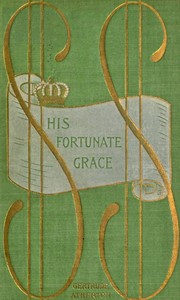
For His fortunate Grace — Context and Discussion, the stored edition analysis reports 36,241 words, 2 hr 38 min estimated reading time, and 25 detected text sections.
The text analysis averages about 13.9 words per sentence, while the detected sections provide another way to judge how the source is divided.
Project Gutenberg metadata also associates the work with “Courtship -- Fiction,” connecting these edition facts with the source record’s subject description.
Explore this collection
These alternatives are selected using recorded categories and estimated reading time.
About 140 minutes
Marriage Society
32,076 recorded words. 18 minutes difference from this book's estimate.
View Gutenberg source #54940About 135 minutes
Marriage Society
30,957 recorded words. 23 minutes difference from this book's estimate.
View Gutenberg source #54941About 127 minutes
Marriage Society
29,174 recorded words. 31 minutes difference from this book's estimate.
View Gutenberg source #54942Search stored excerpts and compare books → Choose by your preferences →
Choices use stored catalog measurements. Estimates vary with reading speed. A shared category is a catalog label, not a claim that two books have the same argument or literary quality.
Search reads excerpt text stored with this catalog and links to its associated Gutenberg record. The connection is stored in the site database; this tool does not recheck that every excerpt is word-for-word identical to that external record. Excerpt search does not cover every chapter and does not verify historical publication dates.
Catalog snapshot checked: 2026-09-26. Coverage: 89 public books, 89 available source excerpts.
Calculated from edition completeness, EPUB availability, text structure and catalogue metadata. Not a user rating.
Total of 100 points, scaled to a 2.5-5.0 range. Editions with an empty description or a missing EPUB file are not scored.
Public-domain source text
The source text is kept in the dedicated reader, separate from this catalogue record and its commentary.
The novel opens with a breakfast-table debate between Augusta Forbes and her father, where the heiress declares her commitment to socialism and women's suffrage, having read Karl Marx and Henry George. Her father's dry retorts—"You darling sarcastic thing"—establish a tone of intellectual sparring that pervades the excerpts. Augusta's club of girls who "aspire to be something more than fashionable butterflies" signals a generational tension between reformist ideals and the social pressures of New York's elite.
The excerpts rely heavily on rapid, argumentative dialogue to advance conflicting positions on wealth, marriage, and national identity. In Chapter I, Augusta's father challenges her plans with pointed questions: "Suppose you fall in love and want to marry?" Her reply—"A woman's chief end is not matrimony"—is immediately undercut by her later admission that she wants to be in love "dreadfully." This contradiction between stated principle and personal desire recurs. In a later scene, Alexis Maitland urges Augusta to "dismiss the Duke of Bosworth" and marry an American, arguing that such a choice would raise the self-esteem of American men. Augusta counters with a pragmatic retreat: "Theories sometimes collide with facts." The dialogue thus becomes a stage for testing abstract ideals against social realities, with each character's voice tied to a distinct position—Augusta's evolving pragmatism, Alexis's idealism, Mrs. Burr's cynical realism.
Augusta's wealth is a constant undercurrent. Her father notes he is "good for twenty or thirty years yet," implying her control over the fortune is deferred. The catalog subject "Children of the rich" finds direct expression in Augusta's plan to use her inheritance for socialist redistribution, yet the excerpts show her father's will as a present obstacle. When Augusta later asks Mabel Creighton if marrying the Duke would be dishonourable, Mabel's reply—"I don't call that kind of thing honour"—suggests a code of conduct among the wealthy that transcends legal or political commitments. The novel's title, His Fortunate Grace, may refer to the Duke, but the excerpts focus on the women who negotiate their own fortunes—financial and emotional—within a system that grants them limited agency.
The excerpts are set in domestic interiors—the Forbes breakfast-room, Mabel Creighton's boudoir with its "rainbow pillows" and silver smelling-salts. These spaces are arenas for private debate that reflects public anxieties about class and national character. Augusta's father reads a newspaper; the women discuss petitions and marriage strategies. The catalog subject "United States — Social life and customs — 19th century" is evoked through details like the "French morning-toilette" and the exclusion of the nouveau riche from reform petitions. The characters move between New York and England—the Duke is a foreign element—but the excerpts remain firmly in American drawing-rooms, where the "air" of fashion and the weight of old money shape every conversation.
The excerpts break off before the Duke appears or Augusta's decision is fully explored. What remains is a series of unresolved debates: can a wealthy heiress be a socialist? Should she marry for love, reform, or status? The novel's short length (36,241 words) and 25 text sections suggest a compact narrative, but the excerpts offer no resolution. Readers should attend to how the dialogue—often witty and pointed—carries the burden of characterization and theme. The absence of descriptive passages in the excerpts may indicate a style that prioritizes conversation over setting or action.
Readers approaching His Fortunate Grace should watch for how the dialogue shifts between earnest reform and social maneuvering. The excerpts suggest a novel less concerned with plot than with the clash of ideas among a small set of characters. Pay attention to who gets the last word in each exchange—it often signals a temporary victory in the ongoing argument about what a woman of wealth and conscience should do.
That rainy afternoon, I kept returning to Augusta’s sharp retorts about titled husbands, the way she prized a man’s character over his crest. Later, restless, I picked up What Answer? — Reading Companion almost by chance, and found the same quiet wince—how we inherit our prejudices, and how slowly we let them go.
Create a short personal record of your experience with this book.